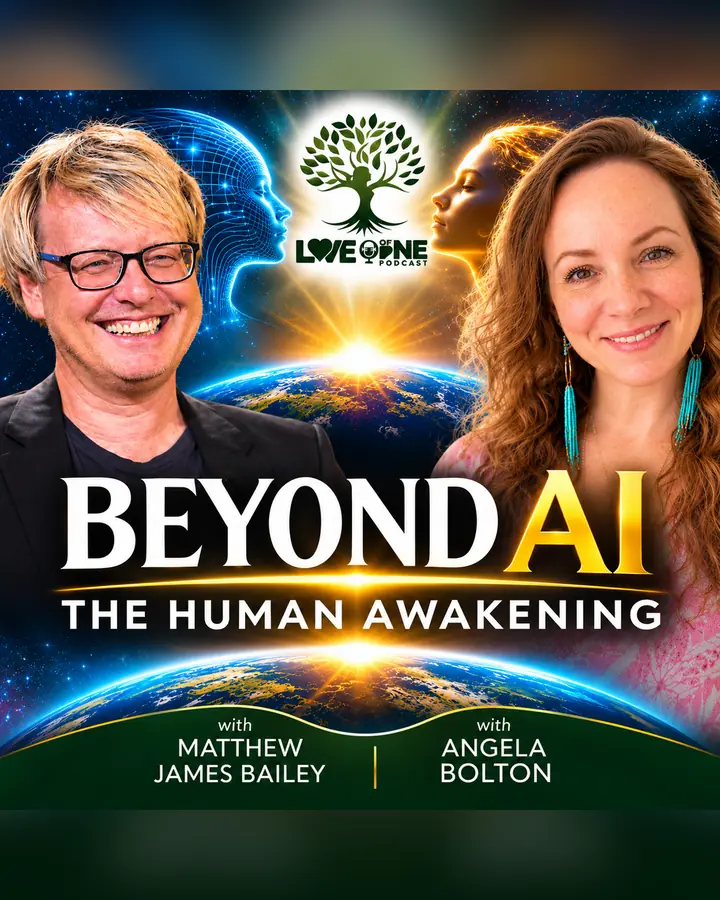
Beyond AI: The Human Awakening
What happens to being human in the age of AI?
Artificial intelligence is reshaping careers, industries and ordinary days, and most of the public conversation about it stays on productivity: what it can do, how fast, and who it replaces. This episode starts somewhere else. Angela Bolton welcomes back Matthew James Bailey, an author and advocate for ethical AI, to ask what the technology is doing to human consciousness, creativity and purpose, and what people might choose to become alongside it.
It is one of the longest conversations the podcast has recorded. Angela brings her own years in corporate technology and systems to it, and the thread that runs through the whole of it is that the values and behavior behind a technology matter as much as the technology does.
What the conversation covers
- Meaning and creativity. If AI takes over more of the work, whether the time it frees goes to more work or to creativity, connection and joy, and why authentic human expression matters more now, not less.
- AI consciousness and human consciousness. What the difference between the two might be, and why the question is still open.
- The cost of the data centers. The energy, water and land that AI infrastructure draws on, and what it means for the communities around it. Matthew calls these buildings the digital cathedrals.
- Ethics, sovereignty and leadership. Who should control the systems shaping the future, decentralized and community-held technology, regenerative systems in place of extractive ones, and corporate culture and conscious leadership.
- The Cosmology of AI and the Great Hello. Matthew’s own framework for a new era of civilization, which he sets out in his work.
- Awakening and human potential. Expanded consciousness, children’s abilities, soul language, and using AI as a tool without handing it your discernment or your voice.
Chapters
- 0:00 Matthew James Bailey returns
- 1:00 Finding meaning and purpose in the age of AI
- 8:00 Human creativity and artificial intelligence
- 17:00 Why human connection still matters
- 21:00 The environmental impact of AI
- 22:00 AI data centers: the digital cathedrals
- 31:00 The Cosmology of AI and the Great Hello
- 37:00 Awakening and human transformation
- 45:00 The soul and expanded consciousness
- 56:00 Ethical AI, corporate culture and leadership
- 1:03:00 Sovereignty and the future of civilization
- 1:13:00 Children’s abilities and human potential
- 1:20:00 Soul language, water and AI exploration
- 1:29:00 Spiritual maturity, discernment and embodiment
About Matthew James Bailey
Matthew James Bailey is an author, speaker and advocate for ethical AI, human sovereignty and conscious approaches to technological and social change. His book Inventing World 3.0: Evolutionary Ethics for Artificial Intelligence sets out his approach to AI ethics, and his Cosmology of AI and civilization toolkit are at inventingworld3.com.
For the narrower question of whether a machine can be conscious at all, an earlier episode, AI and Consciousness, sits beside this one.
Questions people ask
Can AI become conscious?
Nobody knows yet. Whether a machine can be conscious is an open question in philosophy of mind, and there is no agreed test that would settle it. This episode holds it as a live question and spends more of its time on what AI is already changing about human attention, work and connection.
Who is Matthew James Bailey?
An author and speaker on ethical AI and human sovereignty, and the author of Inventing World 3.0: Evolutionary Ethics for Artificial Intelligence. This is his return visit to the Love of One Podcast.
Why does the episode talk about data centers?
Because AI is not weightless. The data centers it runs in draw on large amounts of electricity, water for cooling, and land, and the conversation asks who bears that cost and whether the systems being built are regenerative or extractive.
Watch and listen
The container this one sits next to
If this conversation is close to what you are actually living with, The Recalibration is where that work happens here — 60 minutes. Nothing on the podcast is a pitch for it; the practice and the conversations simply come from the same place.