What Happens When You've Done the Work and Nothing Has Changed
A plateau after an awakening is not a failure of the awakening. It is usually the point at which insight has gone as far as insight can go on its own.
· Angela Bolton
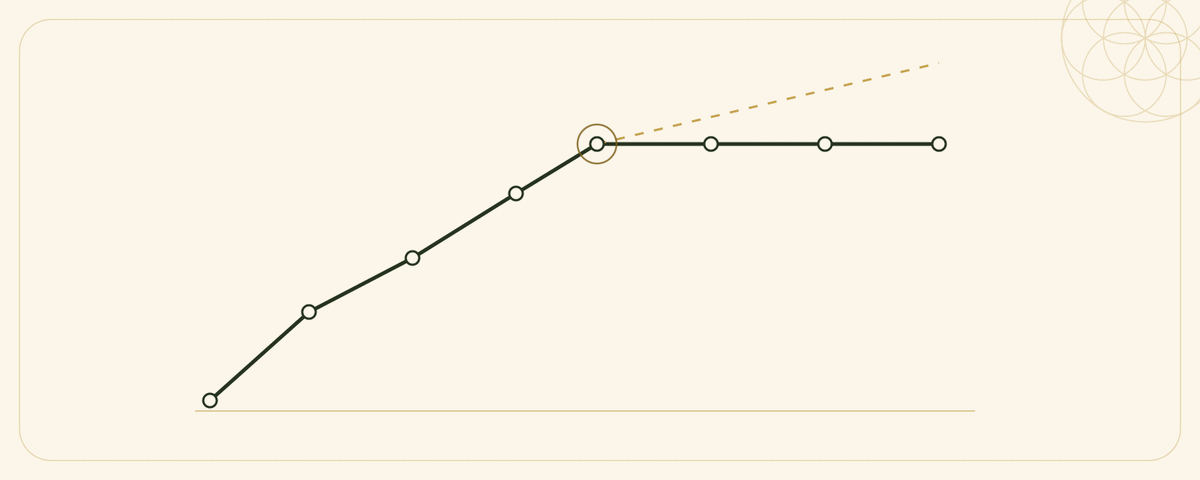
You can tell when someone has reached it. They can describe their patterns precisely. They know the origin of the reaction, the age it belongs to, the shape it takes in their body. They can name it in the moment it happens. And it still happens.
That gap — between accurate understanding and changed living — is one of the most common places for this work to stall, and one of the least discussed, because it is embarrassing in a way that being lost is not. Being lost has a story. Being fluent and unchanged does not.
What is usually missing is not more insight. It is repetition inside ordinary conditions. An insight arrives in a heightened state: a ceremony, a session, a retreat, a long walk after something cracked open. The conditions that produced it are not the conditions you live in. So the insight stays true and stays theoretical, because it has never once been rehearsed on a Tuesday afternoon with a deadline and someone else's bad mood in the room.
The plateau is not a sign to go looking for a stronger experience. It is a sign that the experience needs somewhere to land.
If one hour is not the shape of it
The Threshold exists for exactly this place: three 60-minute sessions across six to eight weeks, so that whatever opens has somewhere to keep moving instead of being re-opened from cold each time. Its value is continuity, not a discount.